 Iqbal Jakati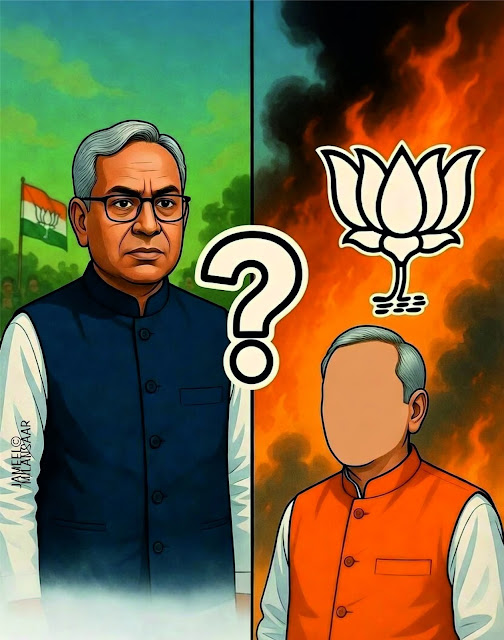
Nitish’s Exit and BJP’s Ascendancy: Is Bihar Entering a New Political Phase?
The decision to send Nitish Kumar to the Rajya Sabha signals the end of an era in Bihar politics, with the Bharatiya Janata Party (BJP) now poised to take full control of the state’s political leadership. With Home Minister Amit Shah’s statement on March 5, 2026, Bihar’s political landscape appears to be heading toward a historic turning point.
In the complex corridors of Indian politics, where alliances shift like the currents of the Ganga, Nitish Kumar’s decision to contest the Rajya Sabha election marks a significant political transition. On March 5, 2026, Nitish Kumar filed his nomination for the Rajya Sabha in the presence of Amit Shah.
Kumar, who served as Bihar’s Chief Minister for nearly two decades, is now stepping aside, seemingly for a quieter role in the Upper House of Parliament. However, this is not merely a graceful retirement—it appears to be a carefully managed political transition. Once elected, Nitish Kumar is expected to vacate the Chief Minister’s post, paving the way for a BJP leader to assume the state’s leadership.
This development could formally place Bihar under stronger BJP political dominance. The saffron wave that had been gradually strengthening in the state may now assert itself more directly, potentially transforming Bihar’s political balance.
Nitish Kumar, often referred to as “Sushasan Babu” (Mr. Good Governance), was widely accepted by Bihar’s voters for his governance model. Now, he appears to be quietly moved to the Rajya Sabha by the BJP leadership. There has been no dramatic announcement of his removal—only subtle praise from Amit Shah, who recently commended Nitish Kumar’s “remarkable tenure,” a statement many interpret as a symbolic farewell.
For years, the BJP struggled to win Bihar on its own strength. Many of its electoral successes were achieved through the alliance with Nitish Kumar and the appeal he held among voters.
The 2025 Bihar Assembly elections serve as a reminder. Even amid reports of Nitish Kumar’s ill health and speculation that he was not fully controlling political decisions, the BJP relied heavily on his image and leadership during the campaign. His face appeared prominently on posters and campaign material, helping the alliance secure victory.
Now that Nitish Kumar is stepping aside, questions are being raised: will his loyal supporters—particularly the committed Janata Dal (United) workers who regarded him as Bihar’s political stabilizer—accept this transition easily?
For years, BJP and JD(U) workers have collaborated closely on the ground, building personal and political relationships despite occasional public disagreements between their leaders. But beneath this partnership lies a political reality: the BJP’s ideological and organizational machinery has grown significantly stronger.
With Nitish Kumar moving out of the Chief Minister’s role, political discussions across Patna suggest that Bihar may now move into a phase of clearer BJP leadership.
Nitish Kumar’s political journey has been dramatic—almost Shakespearean. From his socialist roots to several political realignments, including leaving the BJP in 2013 over Narendra Modi’s rise, returning to the alliance in 2017, and later forming the Mahagathbandhan in 2022, his career reflects the complex survival strategies of Indian coalition politics.
His latest move raises many questions. Is it the price of remaining within a BJP-dominated National Democratic Alliance (NDA)? Or have age and health reduced his bargaining power in the political arena?
Regardless of the reasons, Bihar now stands at a critical political crossroads. Under Nitish Kumar’s leadership, the state saw improvements in law and order and infrastructure development. The coming years will determine how Bihar’s governance and political direction evolve under new leadership.
One question continues to echo across political circles: Will Nitish Kumar’s support base accept this transition, or will it reshape Bihar’s political equations once again?
As many political observers in the Hindi heartland remark:
“The Nitish Kumar whom the people of Bihar elected with overwhelming support has now quietly been sent to the Rajya Sabha.”
Whether this transition strengthens political stability or triggers new tensions remains to be seen.
Ultimately, this is not just the story of one leader’s political shift—it may also reflect the changing nature of coalition politics in India.
As Bihar moves into a new political chapter, only time—and the verdict of future elections—will determine how deeply this transition reshapes the state’s political landscape.
By Jameel Ahmed Milansar, Bengaluru
Source: Haqeeqat Times